
SFC news published since 2018. See SFC archived content for earlier news articles.
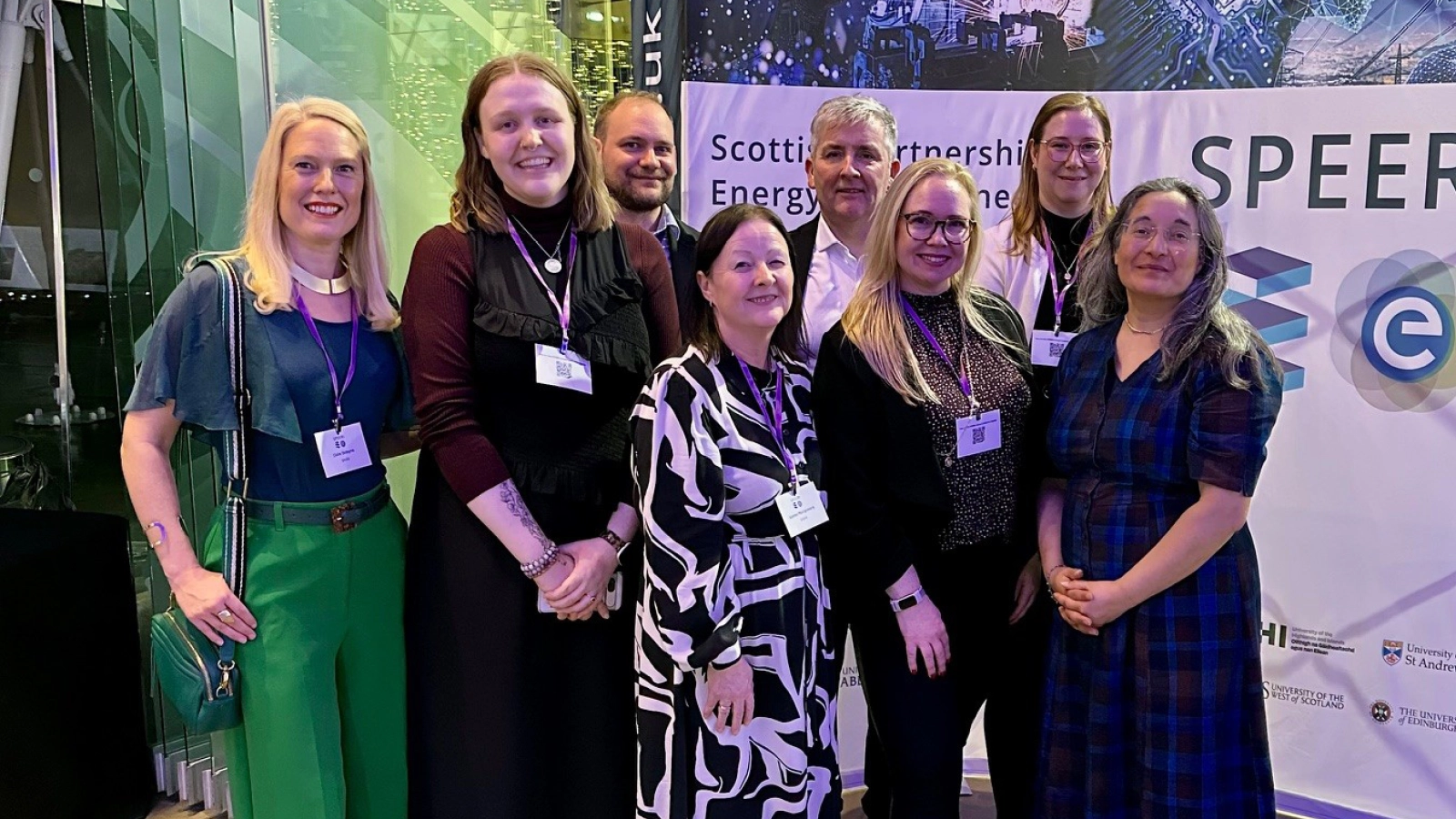
Photo: SPEERI
Today is International Clean Energy Day, a day dedicated to raising awareness and promoting action towards clean, affordable, sustainable, and modern energy for all.
It has also been almost a year since I started my role as Deputy Director (Energy) at the Scottish Partnership in Energy and Engineering Research & Innovation (SPEERI). So, I have taken the opportunity to reflect on the last year, on the clean energy sector and the role of academia and penned a few thoughts.
When reflecting, the one thing stands out above all else: I am genuinely impressed, every single day, by the depth of academic talent we have across Scotland in the clean energy space. Whether I’m speaking with senior professors who have shaped their field for decades, or early career researchers and lecturers who bring fresh drive and new ideas, the passion within Scotland’s academic community is unmistakable. It’s infectious, too. You can’t spend much time around this level of enthusiasm without feeling encouraged about what’s possible for Scotland’s energy future.
What strikes me most is how consistently researchers push boundaries—not just in theory, but in practice. Across the country, academics are developing technologies that will form the backbone of tomorrow’s clean energy systems. This includes advancements in floating offshore wind, such as Heriot-Watt’s Frontline project, which uses autonomous underwater vehicles and satellite monitoring to study the ecosystem impacts of floating turbines.
Researchers are also pioneering marine energy solutions, including a novel monolithic tidal turbine blade design developed at Edinburgh University’s FastBlade facility in Rosyth that reduces material use, manufacturing time, and costs. In addition, battery storage innovation at St Andrews University is exploring novel solid electrolytes that enhance lithium-ion, sodium-ion, and oxide-ion conduction, boosting the performance, safety, and longevity of next-generation batteries.
But the real strength behind these innovations isn’t just technical excellence—it’s the culture of collaboration that Scotland is known for. Collaborative working to maximise impact is core to the SPEERI vision. Over the last year, I’ve seen first-hand how SPEERI provides a collaborative platform which brings together the collective research strengths in energy and engineering of its 14 partner universities and connects them directly to the challenges and opportunities emerging from industry, government, and the public sector. These partnerships make sure that new ideas don’t just sit on a lab bench as theoretical; they translate into real world applications that benefit people’s lives.
A good example of this is the work of the Scottish Research Alliance for Energy, Homes & Livelihoods (SRAEHL), a partnership of 4 Scottish Universities including Stirling, St Andrews, Edinburgh and Strathclyde. Funded by SFC, its vision is to create a collaborative research environment that breaks down silos and delivers practical solutions for energy transition. The alliance focuses on evidence-based policy engagement and real-world impact, tackling challenges such as decarbonising heat, developing financial pathways for large-scale home retrofits, and empowering households to adopt sustainable practices.
This collaborative spirit also drives major hydrogen initiatives. The University of Glasgow’s leadership in the HI-ACT hub and RGU’s role in the METASIS programme show how Scottish universities are working across the UK to solve complex global challenges in hydrogen production and integration.
This spirit of collective problem solving extends well beyond academia. Scotland has always been a country of entrepreneurs, a country that has born some of the greatest innovations the world has seen that are still in use today, Penicillin, telephones and a firm favourite of mine – the television!
This spirit of entrepreneurism has extended into the clean energy space and so many early stage companies I have encountered have either come through the university system or maintain active links with researchers. That connection—between research insight and entrepreneurial drive—is one of Scotland’s greatest strengths and really helps to move ideas from concept to commercial reality at a speed that genuinely makes a difference. This is coupled with a strong innovation support landscape, with organisations such as the regional Enterprise Agencies, the Innovation Centre programme and centres such as the Net Zero Technology Centre, Power Networks Distribution Centre, National Subsea Centre and the National Manufacturing Institute Scotland to name but a few… and of course SPEERI!
Another element that deserves recognition is the role our universities play in nurturing talent. Scotland is training the future engineers, analysts, innovators, and policymakers who will deliver the clean energy transition. The opportunities available to students, whether through interdisciplinary programmes, doctorate programmes, industry placements, or hands on experience in living labs and test environments are exceptional. And having spent time with many of these students and early career researchers, I can confidently say: the future of our workforce is bright.
Reflecting on International Clean Energy Day, I’m reminded that clean energy is a global challenge, but progress depends on local action—on the people and institutions who show up every day to do the work. Scotland’s academic community does exactly that. They ask difficult questions, develop new possibilities, collaborate generously, and push us all forward.
As we accelerate toward net zero, their contributions will be more important than ever. For me, it’s a privilege to work alongside such committed and talented people. Scotland’s universities are more than centres of learning—they are engines of innovation, collaboration, and transformation and they are helping shape a cleaner, fairer, more resilient energy future not only for Scotland, but for communities around the world.
Jennifer Smart
Deputy Director (Energy), Scottish Partnership in Energy and Engineering Research & Innovation
26 January 2026