
The Institute for Global Health and Development at Queen Margaret University (QMU) has a long history of research on vulnerable populations both overseas and in Scotland.
Early in the COVID-19 pandemic, the Institute produced a briefing paper commissioned by the Department for International Development and the National Institute of Health Research which provided guidance to health planners, managers and professionals in planning COVID-19 response globally.
Subsequently, its researchers were invited to advise on identifying and addressing social isolation in refugees in the UK during lockdown. They received requests from the Foreign Commonwealth and Development Office for studies to inform the UK’s aid strategy in Lebanon; Sierra Leone; the Democratic Republic of Congo, Myanmar; and Nepal.
The Institute was also commissioned to advise the United Nations Relief and Works Agency regarding COVID-19 prevention and treatment in Gaza and Lebanon. Additionally, it was invited to support the World Health Organisation in Gaziantep (Turkey) in planning a strategy for north-west Syria through a virtual implementation of the Institute’s group modelling methodology. In Azerbaijan its researchers supported the Government’s response to the mental health burden of COVID-19.
In Scotland, with funding from Scottish Government, the Institute worked with QMU’s Psychology Department to research the impacts of COVID-19 restrictions on loneliness on Scotland’s refugees and asylum seekers. The research demonstrated the effects of sudden-onset isolation, whilst challenging assumptions that isolation inevitably results in loneliness and poor mental health.
Through action-research in collaboration with refugee support organisations, the Institute also documented the experiences of these marginalised groups and identified coping, resilience and effective support mechanisms.
InGAME, led by Abertay University is one of the nine initiatives that form the Creative Industries Cluster Programme launched in 2018.
With a growing number of digital agencies and over 3,500 jobs in digital technology, the creative industries sector in Dundee forms a larger part of the local economy than for any other city in the UK of a similar size.
According to Director, Sean Taylor, the Cluster for Computer Games formalises a relationship that has existed between industry and academia in Dundee for many years. Abertay University established the world’s first computer games course in 1997, and became the UK Centre for Excellence in Computer Games Education in 2009.
The Cluster has actively managed its funds to grow new companies and support existing ones with the constant objective of developing new products and services to create new jobs. To develop the creative community in Dundee, the Cluster has provided a range of activities including the co-creation of working prototypes; forming a virtual community of engagement; offering business vouchers, secondments and workshops; and designing frameworks for evaluation and reporting.
Its research has had a substantial impact on the creative industries sector regionally and across Scotland, and its successes include fostering a globally competitive, entrepreneurial, inclusive and sustainable economy. Amongst its outputs are 633 SMEs participating in engagement events, the creation or safeguarding of almost 600 jobs, the attraction of over £670,000 of funding and three quarters of supported companies releasing new IP material.
ReFLEX will deliver an extensive new pool of flexible demand technologies at regional scale, with the potential to deliver a global impact for our low carbon objectives.
In Scotland, women-owned business accounts for 13% of private sector employment, and around 21% of Scotland’s 339,000 small to medium sized enterprises are majority-led by women. Despite policy interventions, men are still almost twice as likely to start a business as women.
Research conducted by Prof. Norin Arshed at the University of Dundee School of Business has investigated women’s enterprise policy, looking specifically at the enterprise policy process and landscape for women entrepreneurs.
Findings from Prof. Arshed’s research highlighted how top-down gender stereotyping of women entrepreneurs triggered specific responses both in women entrepreneurs and in other stakeholders, undermining policy objectives and destabilising women’s enterprise policy. The findings also exposed how shifting strategic agendas and a lack of resources had a negative effect on policy outcomes.
Arshed’s latest report to the Scottish Parliament gives an in-depth understanding of the effects of COVID-19 on women entrepreneurs in Scotland, highlighting how historical barriers have been amplified by the pandemic. Access to finance in sectors dominated by women was disproportionately affected; barriers to networking were exacerbated; and social and cultural barriers were prevalent. Despite a willingness of enterprise agencies to support women entrepreneurs, much of the support was confusing and generic.
The research findings give voice to women entrepreneurs’ analysis of their own situation, along with views from both public and private organisations associated with enterprise support. Collectively, these findings served to inform the establishment of the £50 million government-backed Women’s Business Centre announced by Scotland’s First Minister in 2021.
Today’s research impact focus is on how the University of the West of Scotland is changing lives in India
The Lab has been cited as an example of ‘best practice’ at GCRF summits in New Delhi and London.
By providing COVID analysis and helping to ensure everyone who needs a test can get one the Glasgow Lighthouse Lab has been a light in dark times. Testing remains a vital part of the UK’s response to COVID-19 as the country cautiously eases out of strict restrictions.
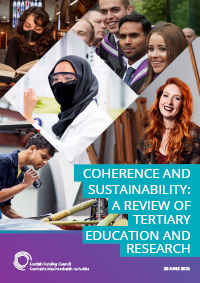
Review of Coherent Provision
and Sustainability
‘We know that the critical opportunities and challenges facing us as a society demand focus from the research community. SFC Alliances for Research Challenges will catalyse Scottish research sector coordination and collaboration to boost research funding and drive research that will benefit us all.’
Through the CommonHealth project at the Yunus Centre for Social Business and Health, GCU research has directly influenced shifts in thinking about how the impact of community-led ‘social enterprises’ generates health and well-being impacts. Furthermore, the Centre’s research into ecosystems and environments that support social innovation has led directly to the establishment of 21 Social Innovation Support Units in Latin America, Southeast Asia and five European regions.
“Our new Gaelic Language Plan recognises the value of Scotland’s linguistic diversity in building connections and enhancing our quality of life. In implementing the plan we will be playing an important role in in supporting Gaelic to thrive in all its communities.”
Tha Comhairle Maoineachaidh na h-Alba (SFC) air a rùn airson taic a chumail ri cànan is cultar soirbheachail na Gàidhlig ath-ùrachadh.
Chaidh an treas eagran de Phlana Gàidhlig SFC fhoillseachadh an-diugh le cuideam air cothroman gus Gàidhlig ionnsachadh ’s a chleachdadh taobh a-staigh colaistean is oilthighean na h-Alba. Le conaltradh coimhearsnachdail, sgaoilidh a’ bhuaidh bhon obair seo thar roinn foghlam nan oilthighean agus bheir i buannachd leis do choimhearsnachdan, àitean-obrach is àrainneachdan ionnsachaidh eile.
Ann an co-bhann ri Sgilean Leasachaidh Alba, rannsaichidh SFC an t-iarrtas airson sgilean Gàidhlig, mar eisimpleir ann an raon nan seirbheisean sòisealta is cùram slàinte, gus freagairtean a dheasachadh dha seo.
Mar thoradh air planaichean roimhe, tha SFC a’ cur a taic ri clàradh sgrìobhte de dh’eachdraidh is cleachdadh gach facail Ghàidhlig a th’ ann ’s a bh’ ann. Nuair a bhios Faclair na Gàidhlig ullamh, bidh e na làn-ghoireas iom-leabhair a chuireas connadh ri fàs is leudachadh foghlam na Gàidhlig aig gach aois is ìre.
Thuirt Karen Watt, Àrd-oifigear airson Comhairle Maoineachaidh na h-Alba:
“Tha ar Plana Gàidhlig ùr ag aithneachadh an luach aig iomadachd cànain na h-Alba airson a bhith a’ togail dhàimhean ’s a’ meudachadh ar cor-beatha. Nuair a chuireas sinn am plana seo an gnìomh, bidh ar pàirt fhèin cudromach mar thaic do Ghàidhlig soirbheachadh sa h-uile coimhearsnachd aice.”
Tha am Plana Gàidhlig 2022-27 aig SFC ri fhaighinn an-dràsta air làrach-lìn SFC.
The Scottish Funding Council (SFC) has today published indicative funding of £2bn for colleges and universities for the next academic year.
In the context of a tight fiscal environment, SFC has prioritised front line teaching and learning for students, with a 2% increase from the AY 2021-22 baseline teaching budgets for both the college and university sectors, equating to an uplift of £9.6m and £14.3m respectively.
The allocations underline our commitment to support productive learning opportunities at a time of significant economic and social uncertainty; to sustain a pipeline of educated and skilled people who will be critical for Scotland’s economic and wellbeing recovery; and to minimise the impact of COVID-19 on students’ learning, addressing the loss of learning for existing students as well as school pupils moving on to tertiary education.
In line with our commitment to work based learning, we will continue to protect and promote the Graduate Apprenticeship (GA) and Foundation Apprenticeship (FA) programmes, working closely with Skills Development Scotland, as we embed funding for FAs and GAs within our core teaching funding.
Today’s announcement also recognises the importance of protecting vital investment in our university research and innovation base with a £4.7m increase in research funding to support universities in their efforts to discover new knowledge and translate that knowledge into benefits for health, economic prosperity and wider social impact.
The impact of research carried out in Scottish universities is highlighted in a new report published today by the Scottish Funding Council (SFC).
The report looks at research that contributes to the United Nations’ 17 sustainable development goals. The goals are part of the international 2030 Agenda for Sustainable Development, described by the UN as a blueprint for peace and prosperity for people and the planet.
Each of Scotland’s universities undertakes sustainable development research, often in partnership with institutions and agencies in other countries. Six Scottish universities appeared in the top 200 in the most recent world rankings of universities’ contribution to the UN goals. The rankings cover 94 countries and include 1,118 universities.
Scottish research has contributed particularly to the UN goals of ending hunger; improving clean water and sanitation; ensuring affordable and clean energy; and addressing climate change.
Amongst the examples in the report is a pioneering project led by the University of Aberdeen to develop a disease resistant rice crop, and the part researchers from Queen Margaret University played in treating and preventing COVID-19 in Gaza and Lebanon. Case studies also include work carried out at the University of St Andrews to protect whales from the impact of naval sonar, and a project at Heriot-Watt University to create a smart energy island.
Today’s report also highlights the effect university research has on Scotland’s National Performance Framework with case studies that illustrate the benefits being achieved in key areas such as health, the environment, social justice and fair work.
Minister for Higher and Further Education Jamie Hepburn said:
“University research drives forward the improvements and innovations needed to help us reach our economic, societal and environmental aims.
“This report highlights the value and scope of our research base, and the international recognition Scotland receives as a key partner in solving global challenges.”
Mike Cantlay, Chair of the Scottish Funding Council, said:
“Today’s report paints an incredibly clear picture of the impact research carried out here in Scotland has on communities both here and throughout the world. Its benefits extend to the health of the planet’s oceans and, crucially, to the creation of a carbon-free future.
“By contributing so strongly to the UN’s Agenda for Sustainable Development, our universities are helping to enhance Scotland’s international reputation and strengthen our relationship with other countries.”
UK Research & Innovation (UKRI) has today published its five year strategy for 2022-27, Transforming Tomorrow Together. This publication marks a major milestone for UKRI, being the launch of their first strategy. It looks ahead to the next 5 years with the ambition to foster an outstanding research and innovation system that drives economic, social, environmental and cultural benefits for all citizens.
The strategy sets out six strategic objectives:
- World-class people and careers.
- World-class places.
- World-class ideas.
- World-class innovation.
- World-class impacts.
- A world-class organisation.
As a key partner of UKRI, SFC welcomes the new strategy and the vision for the UK research system it sets out. Commenting on its publication, Stuart Fancey, SFC Director of Research and Innovation, said:
“We share much of this vision for Scotland’s research and innovation ecosystem. It resonates well with the ambitions we set out in our Review of Tertiary Education and Research, including the protection of fundamental discovery-driven research, looking through a lens of national challenges to better support ideas into impact through knowledge exchange, and supporting all those who do this – through inclusive research culture, supporting PGR experiences and beyond.
At this time of challenges and opportunities in the UK’s research landscape and further afield, we look forward to continuing and deepening our partnership with UKRI and making our shared ambitions a reality by harnessing opportunities for Scotland’s research community.”
Four students from The Winning Students programme took home gold or silver medals at this year’s Beijing Olympic Games.
The Winning Students programme has been one of Scottish sport’s success stories over the past fourteen years.
The programme ensures that student athletes get support and flexibility to train and compete while studying at a Scottish college or university. Since its inception in 2008, Winning Student athletes have performed at every Commonwealth and Olympic Games.
The three Men’s Curling silver medallists were Bruce Mouat, who studied International Festival and Event Management with Entrepreneurship at Edinburgh Napier University, Bobby Lammie, who studied Sport and Exercise Science at the University of Stirling and Ross Whyte who is in his 4th year of study at the University of Stirling, studying Sports Studies.
Mili Smith took home a Women’s Curling Gold Medal and studied Psychology at the University of Stirling.
As part of the programme young athletes are supported by scholarships of up to £6,000 a year. The money can be used for a range of sports services such as physiotherapy, coaching, psychology and training as well as academic related expenses such as accommodation, living costs and study fees. Winning Students scholars are identified and nominated by the governing body of their sport and the scholarships are funded by the Scottish Funding Council.
Today the four UK higher education funding bodies (Research England, the Scottish Funding Council, the Higher Education Funding Council for Wales and the Department for the Economy, NI) have launched a consultation on the future UK-wide research assessment system.
The consultation forms one element of the Future Research Assessment Programme (FRAP). Its outcomes will contribute to the broad evidence base being compiled by the funding bodies, alongside a range of evaluations and analyses of the current Research Excellence Framework and advice from the FRAP International Advisory Group.
The consultation offers respondents the opportunity to voice their opinions on the purposes of future exercises, the high-level principles that should underpin their development, as well as future assessment criteria and processes. The consultation also seeks views on how the funding bodies might ensure that bureaucracy is proportionate in future exercises.
‘Consultation is central to FRAP. The REF is a sector-owned exercise, developed and undertaken in partnership with the research community. It is crucial that those who work in and engage with the research sector have their voices heard at this early stage in the development of the next exercise. By holding the consultation at this point, we hope the sector will be able to contribute meaningfully to the design. Running it alongside our evaluations of REF 2021 should also enable us to provide early clarity on the shape of the next exercise and develop a system that is built on robust evidence and reflects the priorities of the sector.’
Catriona Firth, Associate Director for Research Environment, Research England
‘We know that REF plays a key role in driving high-quality research with significant social impact. As the current exercise comes to close, it is important we reflect on the opportunities we have to ensure that a future system continues to drive this, while also supporting a positive research culture and meaningful and diverse research careers. The consultation will help us to understand what the sector wants from an exercise and how we can best achieve these goals.’
Morag Campbell, Assistant Director, Research & Innovation, Scottish Funding Council
The funding bodies will be holding a number of online ‘town hall’ events throughout the consultation period. Further information on dates and how to register will be made available on the FRAP website in the coming weeks.
The consultation runs until noon on 6th May 2022. A summary of responses will be published alongside the outcomes from FRAP in autumn 2022.
According to new figures released by UCAS following the January deadline for university applications, 20,710 Scottish school leavers have applied to a Scottish university this application cycle, equating to 300 additional applicants. Furthermore, the proportion of Scottish 18 year olds applying to university from the most deprived areas has risen to 21.1%, up 0.5 percentage points from last year and up 3.3 percentage points from 2020.
The figures also show that Scotland remains an attractive proposition for students from other parts of the UK and from international markets. Applications from students from the other UK nations have risen by 8.4% since last year and by more than a third compared with two years ago. Meanwhile there has been an increase of 11.6% in applicants from non-EU countries since 2021.
Martin Boyle, Director of Policy, Insight and Analytics said:
“As we continue to navigate the COVID-19 pandemic we are delighted to see that our world-leading universities remain attractive to students both at home and from overseas.
“Given the specific challenges of the last two years, it is particularly encouraging to see an increase in the proportion of 18 year olds from our most deprived areas applying to university which is testament to the work of universities across the country in widening access.”