
SFC news published since 2018. See SFC archived content for earlier news articles.
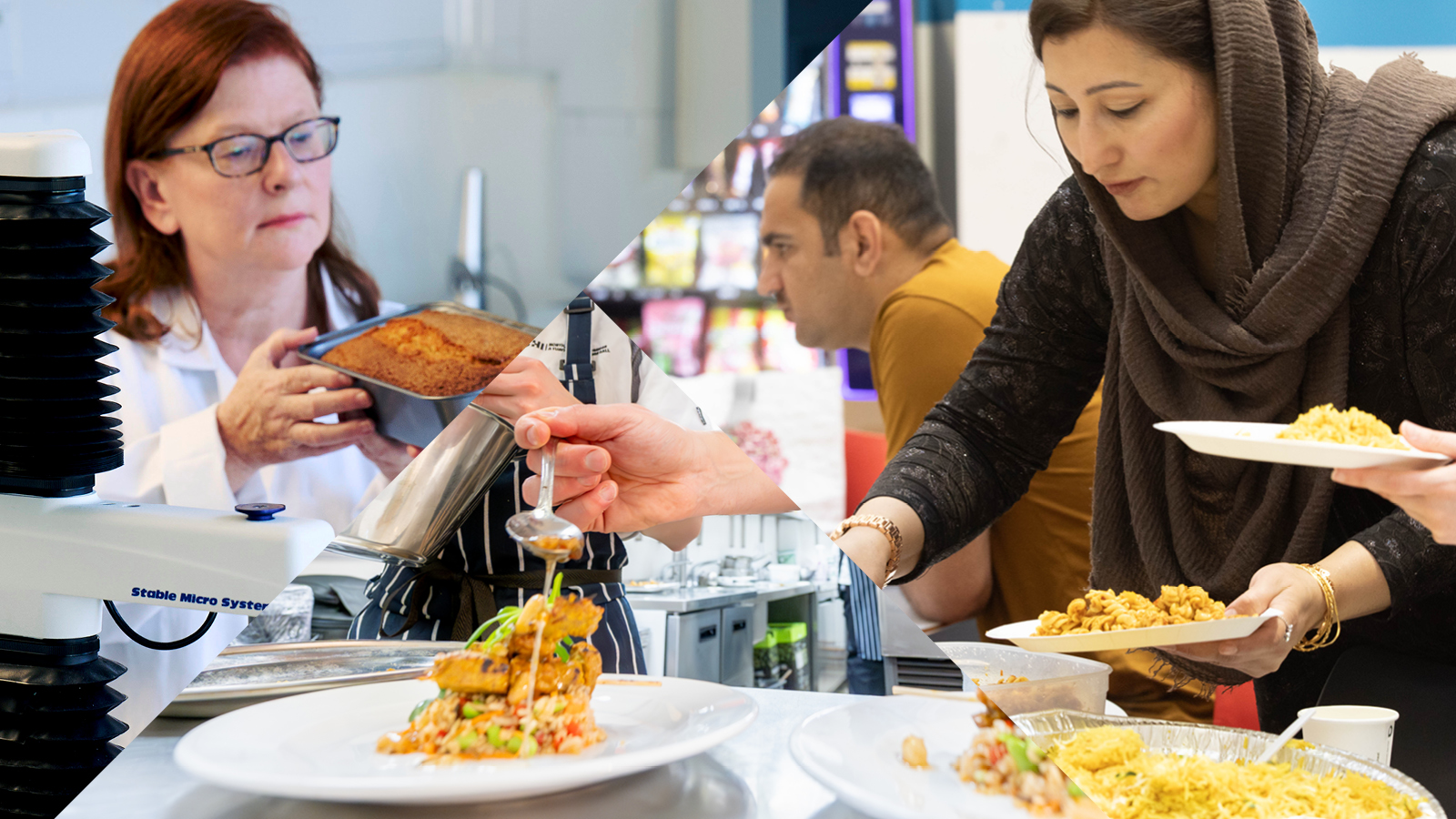
Photos: Queen Margaret University, UHI North, West and Hebrides, Dundee and Angus College
Across Scotland, food waste presents us with both a challenge and an opportunity. Today on International Day of Zero Waste, it’s timely to reflect on how coordinated action across education, industry and government can reduce waste and unlock new value from food residues. The SFC-funded Industrial Biotechnology Innovation Centre (IBioIC) is central to this activity.
When we talk about sustainability in Scotland, the focus is often on system-wide change such as net zero targets, green innovation and economic transformation. But one of the most tangible opportunities exists around something far more familiar: the food we produce, consume and, too often, waste.
Food waste is a cross-cutting issue. It affects households, public services and industry alike. In universities and colleges, it can arise in catering, procurement and estate operations. Across industry—particularly in Scotland’s food, manufacturing, service and retail sectors—it appears at every stage of the value chain.
Addressing this challenge aligns closely with circular economy principles: reducing reliance on finite resources, keeping materials in use for longer and extracting maximum value from what we already produce. Alongside reducing waste, there is growing momentum around novel approaches—treating food waste not as an endpoint, but as a starting point for innovation and value creation.
Scotland already sees some outstanding examples of this activity. The University of Edinburgh and C-Source Renewables have been collaborating to explore how surplus bread can be transformed into a feedstock for the production of sustainable chemicals and medicines. Their project tackles a key technical challenge: how to process carbon from food waste efficiently and consistently. Using a consolidated “one-pot” process with engineered bacteria, bread waste can be broken down and converted into useful outputs in a single system. This biotechnology approach reduces waste, supports a shift away from fossil-based chemical manufacturing, and demonstrates progress towards scalable, commercially viable solutions.
Turning to primary production, farming co-op Grampian Growers has been collaborating with Robert Gordon University and the James Hutton Institute on a project to extract high-value compounds from potato crop residues. This initiative sees a low-value, locally sourced feedstock provide sought-after ingredients for the cosmetics and personal care industry, while also strengthening supply chain resilience and improving returns for Scottish farmers.
Operating at a more systemic level, the recently launched Scottish Ocean Cluster—a collaboration between the Industrial Biotechnology Innovation Centre (IBioIC), Seafood Scotland, Zero Waste Scotland, Aberdeenshire Council and ONE North East—was created to derive greater value from side streams arising from the Scottish seafood sector. By connecting stakeholders across industry, academia and government, the Cluster supports the development of a resource-efficient, circular and innovative blue economy. Projects in the pipeline include the production of construction materials, cosmetic ingredients and nutraceuticals from seafood by-products.
The central role of tertiary education and research across all these initiatives is clear. Universities and colleges are not only developing new technologies, but also supporting the skills, partnerships and knowledge exchange needed to apply them and deliver impact at scale.
Delivering meaningful change to the food system, however, requires more than innovation alone. It depends on alignment across funding, policy, regulation and behaviour—from procurement decisions and infrastructure investment to the everyday choices made by individuals and businesses.
As Zero Waste Day reminds us, progress comes from coordinated action at multiple levels. For individuals, this may start with simple steps like planning meals. For institutions, it could mean embedding circular principles into operations. For industry and policymakers, it involves supporting innovation and pathways to commercialisation.
Taken together, these actions contribute to a shared goal: a more resilient, resource-efficient and sustainable food system. Through its investment in teaching, research and innovation, the Scottish Funding Council plays a vital role in enabling this progress.
Caroline Kewney and Kim Cameron, Senior Impact Managers at IBioIC.